
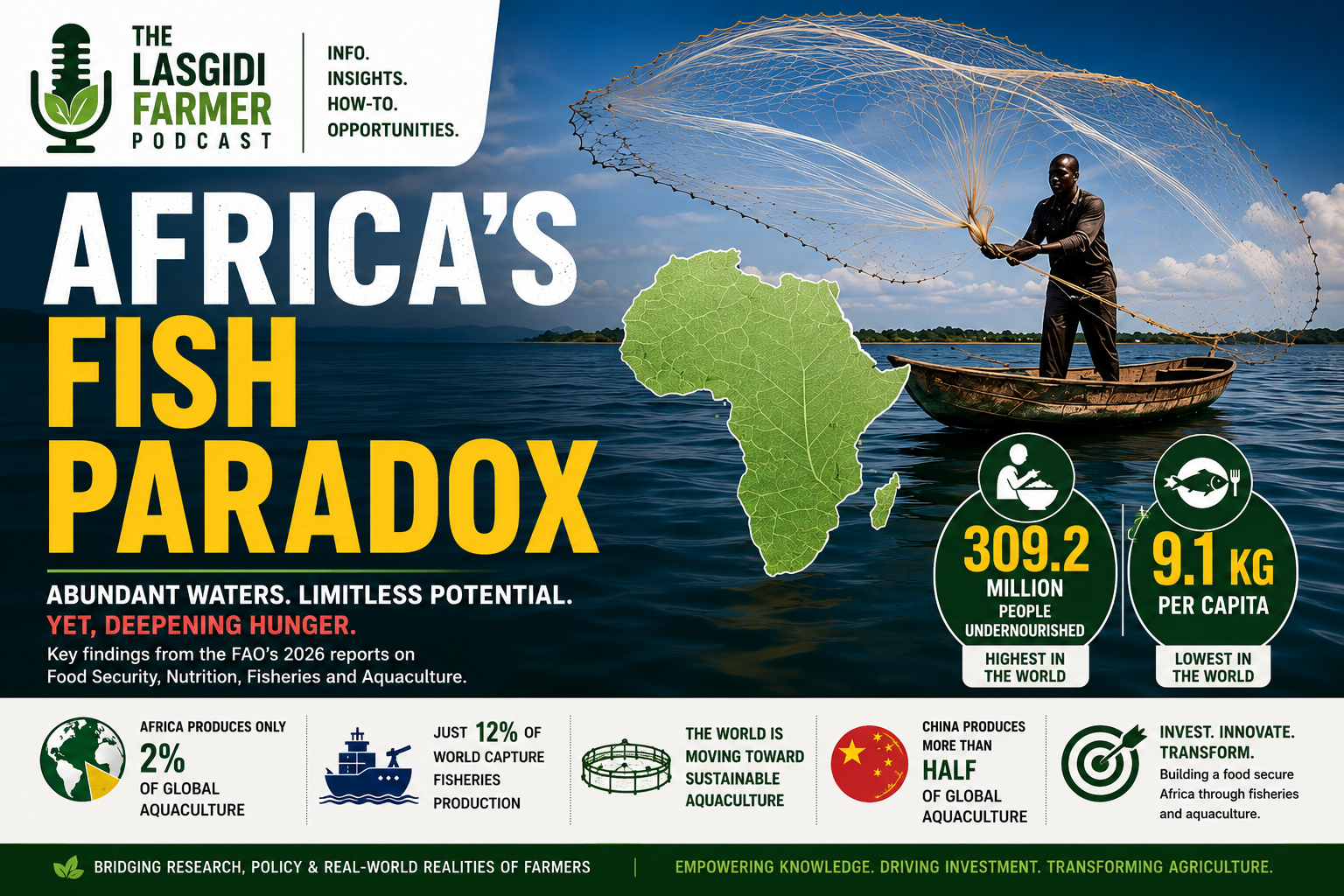
Two disturbing statistics about Africa emerged from the FAO’s 2026 reports on the State of Food Security and Nutrition and the State of World Fisheries and Aquaculture. Together, they reveal a continent facing a deepening food and nutrition challenge.
Which are: Africa not only maintained the position of the highest prevalence of undernourishment and overtook Asia to host the largest number of undernourished people with a 0.6% increase from the preceding year to 309.2 million. The continent, in addition, currently has the lowest per capita aquatic animal food availability (9.1kg).
Aquatic animal food accounts for 20% of animal protein for over 40% of the global population.
The importance of aquatic animal foods for protein security is even more for Africa, as they provide for over 50% of protein in several African countries. The low per capita aquatic animal food availability is thus concerning with the continent’s deeper undernourishment slide.
Africa constitutes just 6% (3rd smallest) of global fisheries and aquaculture productions and also has the 2nd lowest aquatic animal trade ($14 billion) across regions.
Low production and trade which impacts aquatic food availability is paradoxical for a continent with high undernourishment level, huge and rich waters, and aquaculture potentials.
Africa is richly endowed with marine and inland water resources, including over 30,500 km of coastline, more than 13 million km² of Exclusive Economic Zones, vast lakes and rivers, and diverse aquatic biodiversity, giving the continent enormous yet largely untapped potential for fisheries, aquaculture, food security, and economic development.
Rather, Africa accounts for 2% of global aquaculture production but 12% of world capture fisheries production.
While the continent’s water capture is not as large as the rest of the world and represents 4th position of the six assessed regions, this, however, suggests Africa relies heavily on capture fisheries than on expanding sustainable aquaculture.
Water capture is not inherently bad when sustainably pursued, but indiscriminate fishing, crude production, population pressure, and even climate change, regulations and investment shortages are big issues in African waters.
Many countries are increasingly investing in sustainable aquaculture systems -for instance open sea cage fish culturing, and have through this sustainably improved water capture and complementing with aquaculture to increase overall fish output.
China demonstrates what sustained investment in aquaculture can achieve. With sustainable and innovative approaches, the People’s Republic produces more than half of global aquaculture output while also leading capture fisheries. The country is the world’s largest exporter of aquatic animal products and has one of the highest levels of aquatic food availability.
Africa’s trend of open-fishing and without innovation and relying less on aquaculture are contrary to the trend globally where sea cage farming system is rapidly being practiced and aquaculture increasingly forming more percentage of fish output -for instance, fisheries and aquaculture output reached an all-time high of 235 million tonnes with aquaculture share of it rising to 60% and is projected to reach 65% by 2050.
For Africa, expanding aquaculture is no longer simply a fisheries issue, it is critical for reversing undernourishment, strengthening nutrition security, and unlocking economic potential from the continent’s rich waters. Without urgent investment in modern and sustainable aquaculture, fish supply will continue falling behind population growth, perpetuating undernourishment in a continent with vast untapped aquatic resources.